The setting
One-to-one, small-group or online tuition.
Quillattice · for UK tutoring providers
Quillattice helps tutoring providers shape learning content, mathematical data analysis, presentations, visual assets and educational video plans for the learners they work with.
Work can be framed for one-to-one, small-group or online tuition, with the subject, qualification, learner and session in mind.
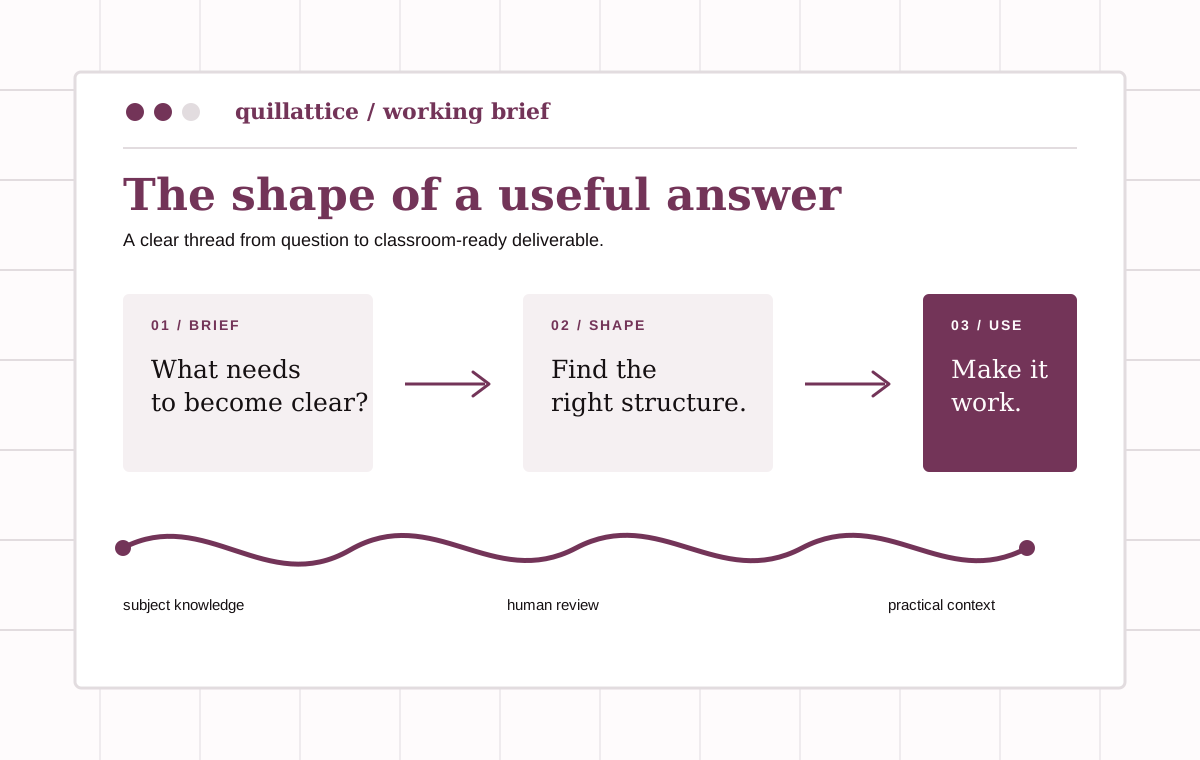
Ways Quillattice can support your work
Start with the teaching need. The format can follow the learner’s level, confidence and the setting where the work will be used.
Shape explanations, questions and worked examples around a subject, exam board or qualification, the learner’s starting point and confidence, and the session context.
Carefully analyse and report assessment, learner or programme data. Make clear what the supplied data shows, where its limits are, and what it cannot establish.
Shape teaching or staff-development presentations with diagrams, charts and graphics around a clear learning idea, audience and purpose.
Plan concise educational videos with scripts, storyboards and supporting materials, each focused on one learning idea and shaped for the learner and session.
Illustrative tutoring resource
This sample shows one possible way to make a method visible before a learner tries a related problem. The topic and support level are examples, not a record of a learner or tutoring brief.
Inspect the full sample portfolioA proposed KS3 algebra example
A ribbon is 20 cm long. Set aside 5 cm. Cut the rest into 3 equal pieces. How long is each piece?
3x + 5 = 20
Try one: solve 4x + 3 = 19.
Proposed KS3 algebra example. Founder review is pending; no pupil use is recorded.
A fit for your tutoring context
A brief can describe how tuition happens, what the learner is working towards and where the work needs to fit.
One-to-one, small-group or online tuition.
Subject, exam board or qualification, learner starting point and current confidence.
What the learner is working on and how the material or insight will be used.
AI-assisted · human-reviewed
AI supports exploration and drafting. Mathematical judgement, classroom context and human review shape the work for accuracy, clarity and fit.
The founder holds a BSc in Mathematics from Loughborough University and a PGCE in Mathematical Education from the University of Leicester. He teaches Maths in a secondary school and has experience with higher-attaining pupils, Further Mathematics and UKMT Mathematical Challenges.
A good place to begin
The existing project brief asks for your organisation, the type of work and the teaching context. Choose “Tutoring provider” in the form.